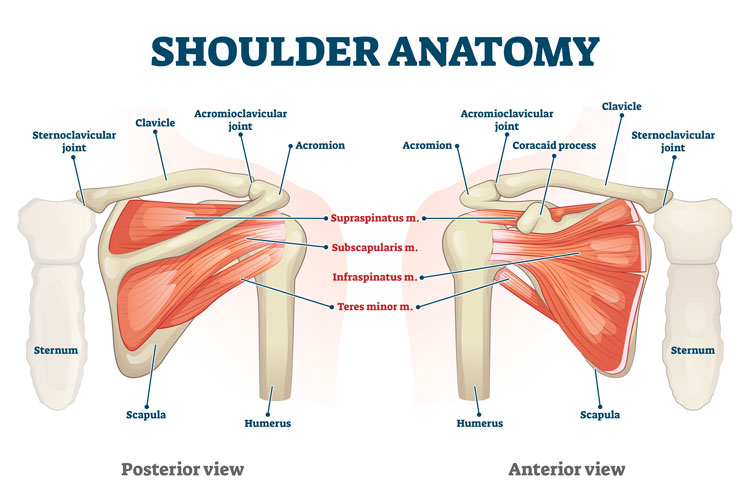
The shoulder is the most flexible joint in the body making it the most susceptible to instability and injury. It is a ‘ball-and-socket’ joint. A ‘ball’ at the top of the upper arm bone, humerus, fits neatly into a ‘socket’, called the glenoid, which is part of the shoulder blade, scapula.
Rotator cuff is the group of tendons in the shoulder joint providing support and enabling wider range of motion. Major injury to these tendons may result in tear of these tendons and the condition is called as rotator cuff tear.
Shoulder impingement is the condition of inflammation of the tendons of the shoulder joint. It is one of the most common causes of pain in the adult shoulder. The shoulder is a ‘ball-and-socket’ joint. A ‘ball’ at the top of the upper arm bone, humerus, fits neatly into a ‘socket’, called the glenoid, which is part of the shoulder blade, scapula. Shoulder impingement is also called as swimmer’s shoulder, tennis shoulder, or rotator cuff tendinitis.
Shoulder instability is a chronic condition that causes frequent dislocations of the shoulder joint. A dislocation occurs when the end of the humerus (the ball portion) partially or completely dislocates from the glenoid (the socket portion) of the shoulder. A partial dislocation is referred as subluxation, whereas the complete separation is referred.
Playing more overhead sports activities and repeated use of shoulder at workplace may lead to sliding of the upper arm bone, the ball portion, from the glenoid–the socket portion of the shoulder. The dislocation might be a partial dislocation (subluxation) or a complete dislocation causing pain and shoulder joint instability. Shoulder joint often dislocates in the forward direction (anterior instability) and it may also dislocate in backward or downward direction.
Frozen shoulder, also called adhesive capsulitis is a condition characterized by pain and loss of motion in shoulder joint. It is more common in older adults aged between 40 and 60 years and is more common in women than men.
Shoulder arthroscopy is a surgical procedure in which an arthroscope is inserted into the shoulder joint. The benefits of arthroscopy are smaller incisions, faster healing, a more rapid recovery, and less scarring. Arthroscopic surgical procedures are often performed on an outpatient basis and the patient is able to return home on the same day.
The shoulder is a highly movable body joint that allows various movements of the arm. It is a ball and socket joint, where the head of the humerus (upper arm bone) articulates with the socket of the scapula (shoulder blade) called the glenoid.